Is Vending Machine Business Passive Income? Here’s What Most People Get Wrong
[

[

](/) HomeAbout UsCase StudiesMachine MarketplaceVending LeadsVending CPA ExpertsMachine FinancingVending InsuranceContact Us HomeAbout UsCase StudiesNewsVending MarketplaceVending LeadsVending CPA ExpertsMachine FinancingVending InsuranceContact Us January 3, 2026
Vending machines aren't passive income; operators spend 2 hours weekly restocking per machine and earn $500 gross monthly revenue. Successful ventures need 300 machines, but face high maintenance and inventory costs. Vending Preneurs offers property owners in Eugene true hands-off profits via revenue-sharing, zero upfront costs, and full management. Gain tenant satisfaction and steady income without effort.
Dreaming of passive income from vending machines in Eugene's busy offices and apartments? Most operators get hit hard by surprise restocking time, repair costs, and underwhelming sales. This article exposes those myths and reveals how Vending Preneurs' revenue-sharing model delivers true hands-off profits with no upfront costs.
Introduction
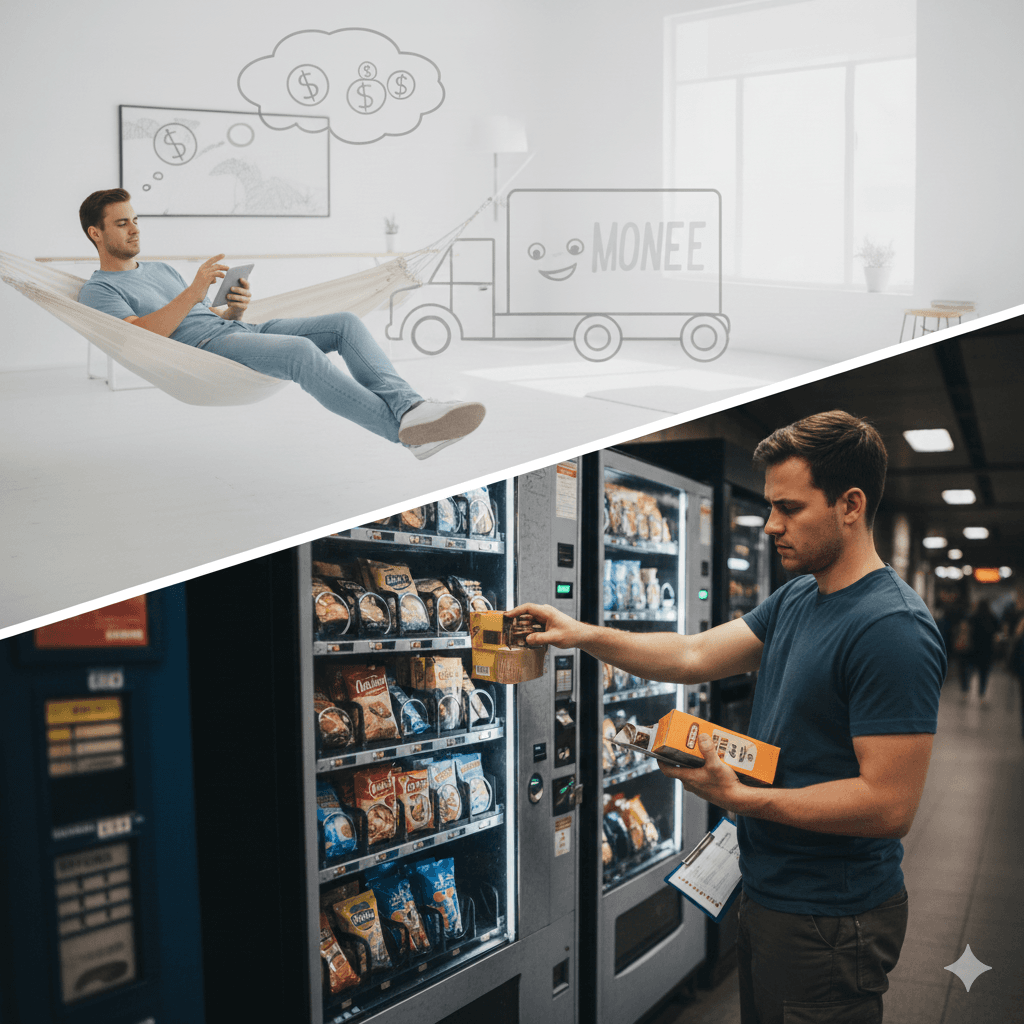
You have probably seen the videos on social media. Influencers claim you can buy a vending machine, place it in a local business, and watch the money roll in while you sleep. It sounds like the perfect side hustle. But here is the thing: for most people, the "passive" part is a myth.
The reality of the vending industry is much grittier than the internet suggests. It involves logistics, repairs, and constant inventory management. While it can be profitable, it is rarely hands-off. In fact, the industry estimate of $500 gross monthly revenue per typical machine is often misleading, leading many beginners to overestimate their potential earnings (Wall Street Journal).
What Is a Vending Machine Business?
A vending machine business is not just about owning hardware; it is a full-scale retail operation. You are essentially running a miniature convenience store that requires stocking, cleaning, and maintenance. Success depends on volume and route density.
To make a full-time living, you need scale. The typical successful vending operator owns nearly 300 machines, not just one or two (Wall Street Journal). This isn't a "set it and forget it" investment. It is a logistics company that moves food and beverages from warehouses to end-users efficiently.
The Allure of Passive Income from Vending Machines
The appeal is obvious. The idea of earning cash 24/7 without trading time for money is the ultimate financial goal for many. People are drawn to the low barrier to entry compared to buying real estate or starting a tech company.
The promise is that these machines "can provide extra income as a side hustle or even replace a full-time salary, creating passive income sources from vending machines" (Healthy YOU Vending). This marketing hooks people who want financial freedom, but it often glosses over the labor required to keep that income flowing.
Why Vending Machines Aren't Truly Passive Income
If you have to drive to a location, load boxes of soda, count quarters, and fix a jammed coil, you are working a job, not earning passive income. True passive income requires zero daily effort, like a dividend stock. Vending is active work.
As industry experts note, "Vending machines are not passive income… This business requires consistent attention, problem-solving skills, and hands-on management" (Under30CEO). If you stop working, the machine empties out, breaks down, and the money stops coming in.
Overestimating Foot Traffic and Sales
Location is everything, but it is hard to predict. You might think a gym or office lobby is a goldmine, but if the foot traffic does not convert to sales, you lose money.
In one experiment, a poor location with four machines earned only $900 over 40 days. In contrast, a single machine in a prime location earned $60 per day (Under30CEO). The gap between a "good" spot and a "bad" spot is massive.
Ignoring Hidden Maintenance Costs
Machines break. Coin mechanisms jam, card readers lose signal, and refrigeration units fail. When you buy used machines to save money, you often inherit these problems.
One operator reported that older machines malfunctioned and card readers failed, requiring costly service trips that ate into all the profits. Every time you have to drive out to fix a jam, your hourly wage drops drastically.
Underestimating Time for Restocking and Cash Collection
Even if your machine works perfectly, it needs to be filled. You have to buy product, transport it, and load it.
If you have 10 machines, that is 20 hours of labor. That is a part-time job, not a passive investment.
How a Traditional Vending Machine Business Really Works
Successful operators treat this as a territory war. You are fighting for the best square footage in town. It is not about snacks; it is about securing the rights to sell in a specific lobby or breakroom.
"The most successful vending machine operators understand that this is fundamentally a real estate business" (Under30CEO). You need to secure contracts, often paying a commission to the building owner, just to place your hardware.
Step 1: Acquiring and Placing Machines
Starting up costs real capital. You need to buy the machines, a truck or van, and moving equipment. Then you have to negotiate with business owners to let you in.
In one case study, a new operator spent $5,000 on 4 machines and even had to pay to acquire a location contract (Under30CEO). This upfront risk is significant before you sell a single candy bar.
Step 2: Stocking Products and Managing Inventory
You cannot sell empty air. You need to buy inventory upfront, which ties up your cash flow. You also need a place to store it so it doesn't melt or expire.
One operator found they had tied up about $2,000 in product inventory just to keep four machines running. If that product doesn't sell fast enough, it expires, and you lose your investment.
Step 3: Handling Payments, Repairs, and Compliance
Modern customers want to pay with cards or phones. This means you need telemetry devices and merchant accounts. These systems have fees and technical glitches.
Operators have reported issues where card readers placed $10 holds on bank accounts, deterring sales, while older machines frequently malfunctioned. Dealing with angry customers who didn't get their chips is part of the daily grind.
Best Practices for Vending Machine Success
If you are determined to run the machines yourself, you must be strategic. You cannot just guess. You need systems, better hardware, and data.
Expert advice suggests "investing in high-quality machines that require minimal maintenance and implementing inventory tracking software to optimize routes" (Healthy YOU Vending). Cheap machines cost more in the long run due to downtime.
Choose High-Traffic Locations Strategically
Not all crowds are the same. White-collar workers might go out for lunch, while blue-collar workers often stay on-site and need quick energy.
Data shows that blue-collar workplaces can generate 2-3x more revenue per machine than office spaces (Healthy YOU Vending). Warehouses, manufacturing plants, and automotive shops are often better bets than fancy corporate lobbies.
Leverage Smart Tech for Efficiency
Don't drive to a machine to check if it's empty. Use remote monitoring.
- Telemetry : Check stock levels from your phone.
- Cashless Payments : Accept Apple Pay and credit cards to boost sales.
Technology reduces the "active" time required, though it doesn't eliminate it entirely.
Partner with Managed Services for Scalability
For property managers and business owners, the best practice is often not to become a vending operator at all. Instead of buying machines, you partner with a service that handles it all. This is where the model shifts from "running a business" to "providing an amenity."
Common Mistakes New Vending Operators Make
Many people jump in without a plan and burn out within six months. They underestimate the physical labor and overestimate the demand.
Skipping Location Research
Placing a machine in a spot with low foot traffic is the number one killer of vending businesses. You need daily volume. Without analyzing the demographics and traffic flow, you are gambling. If there is a convenience store next door, your machine will likely fail.
Neglecting Machine Security and Vandalism Risks
Machines are targets. If you place a machine in an unsecured area, you risk theft and vandalism. Repairing a smashed glass front or replacing a broken lock can cost more than the machine earns in a month. Secure, indoor locations are always safer than outdoor or public access spots.
Failing to Adapt to Consumer Trends
Stocking only sugary sodas and chips is a mistake in 2025. People want options. If you ignore trends like energy drinks, healthy snacks, or protein bars, your sales will stagnate. You have to rotate products based on what people actually buy, not just what is cheap at the wholesale club.
The Hands-Off Path: Fully Managed Vending with Vending Preneurs
There is a way to get the benefits of vending—happy tenants and employees—without the work. This is where Vending Preneurs comes in.
We flip the model. Instead of you buying machines and working as a restocker, we provide the entire service. For building owners and facility managers, this transforms a complex operational headache into a simple, value-add amenity.
How Vending Preneurs Delivers True Passive Income
We specialize in smart vending and micro markets for offices, apartments, and student housing. Our model is designed to be completely hands-off for the property manager.
Revenue-Sharing Model with Zero Upfront Costs
You do not pay for the machines. We do.
- No Capital Expenditure: We cover the cost of equipment and installation.
- Profit Sharing: We share a percentage of the revenue with you.
- Risk-Free: If the machine breaks, we pay to fix it.
This is actual passive income. You provide the space; we do the work.
Smart Tech and 24/7 Remote Monitoring
We use the technology that individual operators often can't afford. Our machines are connected to the cloud 24/7.
- Real-Time Data : We know what sells and when to restock.
- Proactive Repair : We often know a machine has an issue before you do.
- Contactless Payment : Users can pay easily with phones or cards.
Customized Solutions for Offices and Apartments
One size does not fit all. A luxury apartment complex needs different products than a university dorm.
We curate the product mix to fit your specific demographic. Whether your tenants want organic snacks, local coffee, or late-night essentials, we tailor the inventory to maximize satisfaction and sales.
Getting Started with Vending Preneurs in Eugene and Beyond
If you manage a property, stop thinking about buying a vending machine. Think about hosting one. It is the smarter, more profitable path.
Assess Your Space for Vending Potential
Look at your lobby, breakroom, or common area. Do you have a steady flow of people? Do you have an electrical outlet? That is all you need. We handle the measurements and layout design to ensure the equipment fits perfectly.
Schedule a Free Consultation
Contact us to discuss your needs. We will evaluate your location and recommend the best solution, whether it is a single smart vending machine or a full micro market. We handle the logistics, so you don't have to.
Launch and Earn Revenue Seamlessly
Once we install the machine, your job is done. We stock it, clean it, and service it. You simply improve your tenant experience and collect your share of the revenue. It is the professional, hassle-free way to bring modern convenience to your space.
Conclusion
Is a vending machine business passive income? For the average person buying a machine and filling it themselves, the answer is a hard no. It is a demanding job with real risks.
However, for property owners who partner with Vending Preneurs, the answer is yes. By leveraging our fully managed service, you gain the benefits of on-site refreshments and revenue sharing without lifting a finger. That is the difference between a side hustle and a true amenity.
Frequently Asked Questions
How much does a vending machine cost to buy?
New vending machines cost $3,000 to $10,000 each, while used ones range from $1,200 to $3,000. Factor in additional startup expenses like a vehicle ($5,000+) and initial inventory ($2,000 for 4 machines).
What are the best locations for vending machines?
Blue-collar workplaces like warehouses and manufacturing plants generate 2-3x more revenue than offices due to higher on-site snacking. Prioritize indoor, high-traffic spots with steady foot traffic over low-volume areas.
How often do vending machines need restocking?
High-performing machines require restocking every 2-3 days, or about 2 hours weekly per machine. With 10 machines, expect 20 hours of labor for efficient inventory management.
What profit margin can vending machines achieve?
After COGS (40-50%), location commissions (10-25%), and other costs, net profit margins average 20-30% on revenue. A $500 monthly gross machine might yield $100-150 profit.
How does Vending Preneurs revenue sharing work?
Property owners get 20-30% of net revenue with zero upfront costs or maintenance. We install, stock, and repair machines, delivering passive income from day one via monthly payouts.
[
](#) HomeAbout UsCase StudiesNewsVending MarketplaceVending LeadsVending CPA ExpertsMachine FinancingVending Insurance Contact Us Terms Privacy Policy