How Much Money Do Vending Machines Really Make: Real Numbers Explained (2026 Data)
[

[

](/) HomeAbout UsCase StudiesMachine MarketplaceVending LeadsVending CPA ExpertsMachine FinancingVending InsuranceContact Us HomeAbout UsCase StudiesNewsVending MarketplaceVending LeadsVending CPA ExpertsMachine FinancingVending InsuranceContact Us January 16, 2026
.jpg&w=1200&q=75)
Vending machines average $250 monthly net profit per unit in 2026 U.S. data, reaching $1,000+ in high-traffic spots like warehouses. Revenue hits $100-500/month after 40-50% COGS, 10% commissions. Credit card readers boost sales 20-30%. Scale to 25 machines for $4,000 monthly take-home. Success demands prime locations, fresh stock, reliable tech for consistent earnings.
Dreaming of vending machine riches but scared off by vague promises and empty hype? Most new operators underestimate costs, netting just $250 monthly per machine on average. This guide delivers 2026 U.S. data with real revenue breakdowns, expense truths, and profit formulas to show exactly what your business can earn.
Introduction to Vending Machine Profits
Everyone asks the same question before buying their first machine: is this actually worth my time? The vending industry is attractive because it promises cash flow without a 9-to-5 schedule, but the gap between a hobby and a business is significant. You need to know if the quarters and dollar bills add up to a livable income or just extra pocket money.
The reality is that income varies wildly based on effort and placement. While an average machine might just pay its own bills, highly profitable vending machines can generate $600/month in profit, with high-traffic locations sometimes seeing $1,000 to $3,000+. This guide breaks down exactly what you can expect to earn in the current market.
Busting Common Myths About Vending Machine Earnings
There is a lot of noise online about "passive income" that misleads new operators. The biggest myth is that vending is entirely hands-off. It isn't. You have to restock, fix jams, and handle cash. If you treat it like a set-it-and-forget-it investment, your machines will sit empty and broken.
Another misconception is that the market is too saturated to make money. While prime spots in downtown areas are competitive, the industry is actually growing. In fact, vending machines maintain a success rate of over 80%, which is significantly higher than many other small business startups. The key isn't finding a magical location; it's operational consistency and smart product choices.
Average Revenue and Profit Breakdown (2026 Data)
Understanding the averages helps you set realistic goals. You shouldn't expect to retire on a single machine, but a small route can replace a full-time salary if managed well. Revenue is the total cash collected, but your take-home pay (net profit) is what matters. This depends heavily on your cost of goods and commissions paid to the location owner.
On average, a single machine generates between $100 and $500 per month in profit after expenses. This wide range exists because a machine in a sleepy office breakroom performs very differently from one in a busy manufacturing plant. To scale, you simply multiply these unit economics across a fleet of machines.
Snacks and Drinks Machines
Snack and beverage combos are the backbone of the industry. They rely on volume and healthy profit margins. You buy items in bulk and sell them at a markup. The goal is to keep your Cost of Goods Sold (COGS) low while maintaining prices that customers accept.
Healthy and Specialty Vending
Specialty machines are gaining traction as consumers look for better options than chips and candy. These machines often vend salads, sandwiches, or organic drinks. The financial model here is different: the equipment is more expensive, but the transaction value is much higher.
A healthy cold food machine typically costs between $5,000 and $12,000 upfront. However, because you are selling meals rather than snacks, the average sale ranges from $6 to $12. With profit margins hovering between 35% and 50%, you need fewer sales to hit the same profit targets as a standard snack machine.
High-Traffic Location Benchmarks
Location is the single biggest multiplier for your revenue. A "high-traffic" location isn't just about the number of people; it's about the number of hungry people with no other options. Think airports, large warehouses, or schools.
In these prime spots, the numbers jump significantly. A standard snack or beverage machine in a high-traffic zone often generates $300 per week in revenue. That is over $1,200 a month from one box. Securing these locations usually requires paying a commission to the property owner, but the volume makes it worth the cost.
Key Factors Influencing Vending Machine Income
You can't control the economy, but you can control how you run your route. Profitability usually comes down to three specific levers: where you put the machine, what you put inside it, and how easy it is for people to pay. Ignoring any of these can cut your potential earnings in half.
Here is what drives the numbers:
- Foot Traffic: You need eyes on the machine.
- Captive Audience: People stuck in a location (like a tire shop waiting room) buy more.
- Payment Options: Cash-only machines lose sales to card users.
- Reliability: A broken machine earns zero dollars.
Location and Foot Traffic Impact
The relationship between foot traffic and sales is direct. If 100 people walk by your machine every day, and 5% buy something, that’s 5 sales. If you move that machine to a spot with 1,000 daily passersby, you jump to 50 sales.
However, not all traffic is equal. A gym with 200 members might outperform a mall hallway with 2,000 walkers because the gym members have a specific need (hydration/protein) and are ready to spend. You want locations where people spend time, not just walk past.
Product Selection and Pricing Strategies
Your product mix must match the location demographics. You wouldn't put sugary sodas in a high-end yoga studio, and you shouldn't put expensive organic kale chips in a mechanic's shop. Misaligning products results in expired goods and lost money.
Pricing is also a balancing act. You need to cover your costs and make a profit, but if you price a Snickers bar at $3.00 when the convenience store next door sells it for $1.50, you will lose. Check local competitors and price your items just slightly higher for the convenience factor.
Machine Type and Technology Upgrades
Old machines are cheap to buy but expensive to own. They jam often and usually only accept cash. Modernizing your equipment is one of the fastest ways to increase revenue.
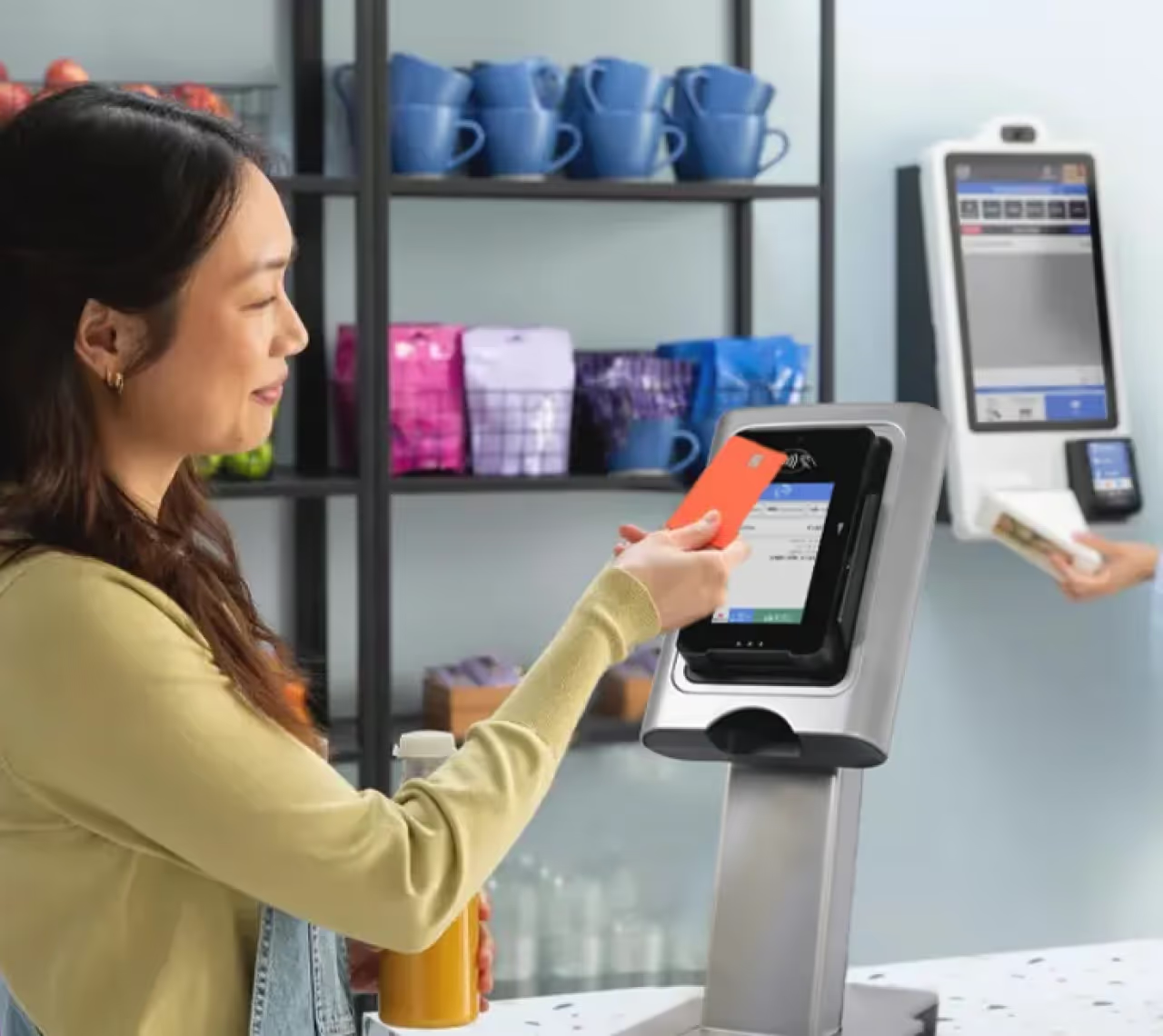
Adding a credit card reader can increase sales by 20-30% immediately. People rarely carry cash, but they always have their phones or cards. Furthermore, machines with remote monitoring software (telemetry) tell you exactly what sold. This saves you gas money because you only visit the machine when it actually needs restocking.
Real Costs of Running Vending Machines
Revenue looks great on paper until you subtract the bills. To understand your true take-home pay, you have to factor in the startup and operational costs. The barrier to entry is low, but it isn't zero.
The biggest upfront cost is the hardware. A simple bulk vending machine (gumball style) might cost $200 to $1,500. A premium coffee machine runs $3,000 to $8,000, and sophisticated hot food machines can climb to $15,000 to $30,000. Beyond the machine, you must budget for inventory, card reader fees, insurance, and commissions paid to the location.
Step-by-Step Profit Calculation for Your Business
Stop guessing and start doing the math. If you are looking at a potential location or evaluating your current route, you need a clear formula. Profit is simply what is left over after every other hand has taken its share.
Use this simple structure to forecast your earnings:
- Estimate Monthly Revenue: (Avg Sales per Day) x (Days Open)
- Subtract COGS: Usually 50% of revenue.
- Subtract Operating Expenses: Commissions, fees, fuel.
- Result: Net Profit.
Estimating Revenue Streams
Start with conservative estimates. If a location has 50 employees, assume maybe 10-15% will buy something daily. If the average item price is $1.50, and you get 5 sales a day, that is $7.50 daily revenue.
Over a month (20 working days), that is $150 in revenue. If the location is open 24/7 or has public traffic, adjust your numbers up. It is always better to underestimate revenue and be pleasantly surprised than to budget for sales that never happen.
Subtracting Expenses
Your expenses fall into two buckets: variable and fixed. Variable costs change with sales. This includes the Cost of Goods Sold (usually about 40-50% of revenue) and credit card processing fees (typically 5-6% per transaction).
Fixed costs happen whether you sell a candy bar or not. This includes your liability insurance (roughly $500/year divided by 12 months), vending management software fees, and fuel to get to the location. If you pay the location a commission (often 10-15% of sales), deduct that here too.
Net Profit Projections
Let's put it all together. If your machine makes $600 in monthly revenue:
- COGS (50%): -$300
- Commission (10%): -$60
- Card Fees (5%): -$30
- Misc (Gas/Ins): -$50
Total Expenses: $440.
Net Profit: $160.
This means you keep roughly 26% of the gross sales. To make $4,000 a month in take-home pay, you would need about 25 machines performing at this level.
Real-World Case Studies from U.S. Operators
Consider "Sarah," an operator in Ohio. She started with two refurbished snack machines placed in local auto repair shops. Because the mechanics worked long hours and couldn't leave for lunch, her machines averaged $400/month in revenue each. After costs, she cleared about $300 total profit per month. She reinvested that money and now runs 20 machines.
Another example is a duo in Oregon who focused on "healthy vending" in tech offices. They placed high-end machines with card readers selling coconut water and protein bars. Their machine cost was higher ($5,000 each), but their average item sold for $3.50. With just five machines, they generate over $2,000 in net profit monthly because the margins on premium products are thicker and the clientele is less price-sensitive.
Best Practices to Maximize Vending Profits
Success leaves clues. The most profitable operators in the country follow a specific set of rules to keep their margins healthy. It mostly comes down to efficiency and customer satisfaction.
Pro Tip: "Never let a machine sit empty. An empty slot is a lost sale and a frustrated customer who might not come back."
Here are the top habits to build:
- Keep it clean: Wipe down the glass every visit. Dirty machines look broken.
- Rotate stock: If Honey Buns aren't selling, swap them for Pop-Tarts. Don't let dead stock take up space.
- Use technology: Vending management systems (VMS) help you track inventory so you buy exactly what you need.
- Build relationships: Talk to the office manager. They will tell you what people want to buy.
Common Mistakes That Drain Vending Profits
New operators often bleed money because they focus on the wrong things. The most common error is buying a cheap, ancient machine to "save money." If that machine eats a dollar bill and gives no product, you lose the customer forever. Spend the extra money on reliable equipment.
Another pitfall is paying too high a commission. Some locations will ask for 20% or 30% of sales. Unless the foot traffic is massive (like a busy airport terminal), these numbers will destroy your profit margin. Walk away from deals that don't make financial sense. Finally, avoid over-servicing. You don't need to visit a slow machine every two days. It wastes gas and time.
2026 Outlook: Profit Trends and Opportunities
The vending industry is not slowing down. As retail stores struggle with labor costs, automated retail is filling the gap. We are seeing a shift toward "micro-markets" and smart vending that can handle fresh food and higher-ticket items.
The numbers back this up. The global vending machine market is anticipated to grow to $25.0 billion by 2026. In the U.S. specifically, the retail vending market is on a steady upward trajectory. This growth is driven by cashless payment adoption and the demand for instant convenience. Now is an excellent time to enter the market before prime locations are locked down by major competitors.
How Vendingpreneurs Helps You Achieve Real Profits
Starting a vending business requires more than just buying a machine; it requires a strategy. Vendingpreneurs provides the roadmap you need to avoid rookie mistakes. We are a nationwide marketplace and resource hub designed to help you launch and scale.
We offer mentorship to help you secure profitable locations, tools to manage your business, and exclusive discounts on equipment. Whether you need access to financing, insurance, or just a steady stream of leads for new spots, Vendingpreneurs connects you with the resources to build a business that actually generates profit, not just revenue.
Final Thoughts on Vending Machine Success
Vending machines are a legitimate way to build wealth, but they require respect. It is a business of pennies and quarters that adds up to thousands of dollars if managed correctly. The math is simple: control your costs, pick the right locations, and keep your machines full.
You don't need to be a genius to make this work, but you do need to be consistent. Start with one machine, learn the ropes, and scale at your own pace. The opportunity is there for anyone willing to put in the work.
Frequently Asked Questions
How do vending machine regulations work in Eugene, OR?
In Eugene, OR, vending machines require a Lane County business license and health permits for food items from the Oregon Health Authority. Comply with sales tax collection via Oregon Department of Revenue; annual inspections ensure food safety, with fines up to $1,000 for violations.
What financing options exist for vending machines in Oregon?
Oregon operators can access SBA microloans up to $50,000 or local credit unions like SELCO in Eugene offering equipment financing at 6-9% APR. Vendingpreneurs partners provide vendor financing with 0% intro rates for first-time buyers.
How much do vending machines cost used in Eugene, OR?
Used snack vending machines in Eugene sell for $1,200-$3,500 on Craigslist Eugene or Facebook Marketplace. Factor in $200-500 refurbishment; local sellers like Willamette Valley Vending offer warranties, saving 40-60% vs. new.
What are the best vending locations in Eugene, OR?
Top Eugene spots include University of Oregon dorms, PeaceHealth Sacred Heart Medical Center waiting areas, and Autzen Stadium lots, generating 2-3x average revenue. Secure via 10-15% commissions; avoid saturated downtown without captive audiences.
How do I get vending machine insurance in Oregon?
Oregon requires general liability insurance ($500-$1,200/year) through providers like State Farm or Progressive, covering product liability up to $1M. Vending-specific policies from NAFA members add theft protection; shop quotes via Eugene agents for bundles under $800 annually.
[
](#) HomeAbout UsCase StudiesNewsVending MarketplaceVending LeadsVending CPA ExpertsMachine FinancingVending Insurance Contact Us Terms Privacy Policy